[04]
Built for the gaps that content can't close.
CCI's programs aren't courses with extras layered on. They're developmental systems — sequenced specifically to move leaders and employees from awareness to behavioral change.
Every program begins with the CQ Assessment — a psychometrically validated baseline that identifies where each person actually is on specific behavioral dimensions. Not their job title, not their last quiz score — who they actually are. That foundation makes everything downstream genuinely personal.
From there, a multi-layered architecture does what content alone cannot:
Live experiential learning
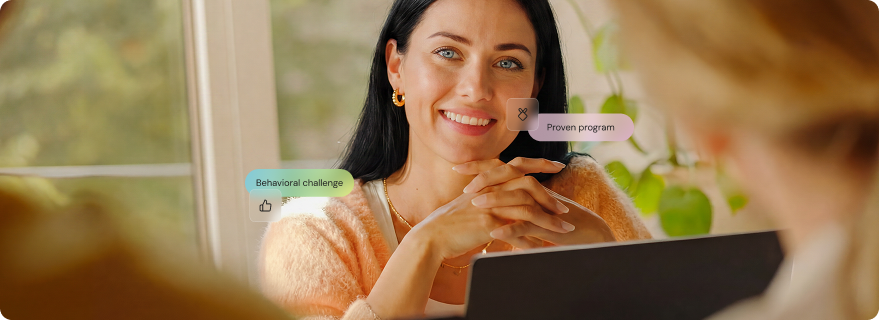
Live experiential learning creates the felt experience and insight that adult learning research identifies as the necessary starting point for real behavioral change. This isn't replicable asynchronously. What happens amongst people— the discomfort, the recognition, the shift — is part of the mechanism.
Structured skill modules and two-way AI coaching conversations
Structured skill modules and two-way AI coaching conversations carry development between sessions — not only through nudges or content drops, but also through responsive dialogue anchored to each individual’s specific profile. There's a meaningful difference between receiving a tip and having a coaching conversation. CCI's AI does both.
Coaching circles and peer cohorts
Coaching circles and peer cohorts bring people together to apply, struggle, and learn from each other's real-world attempts. Deliberate practice sessions — with simulations and expert feedback — are where behavioral change consolidates into performed skill.
And the @SCALE technology sustains it all
Prompting action, reinforcing behavior, and sharing insights directly with managers so they can pull behavioral change through in their teams long after the formal program ends.
Development that stays inside the program isn't development. It's attendance.
.png)
.png)

.png)
.png)
.png)
.png)
.png)
.png)
.png)
.png)


.png)
.png)

.png)
.png)
